Simplifying High-Power Drive Design with Integrated IGBT Solutions
Reading Time: 6 minutes
Simplifying High-Power Drive Design with Integrated IGBT Solutions
Designing the power stage for a 500kW industrial motor drive involves managing dozens of interconnected challenges simultaneously. Gate drive timing must achieve nanosecond precision across six IGBTs switching hundreds of amperes. Thermal interfaces between semiconductors and heatsinks require careful attention to avoid hotspots. Protection circuits must respond to fault conditions within microseconds. Each discrete component adds complexity, potential failure points, and development time.
Power electronics engineers face mounting pressure to reduce development cycles whilst improving reliability in high-power applications. Industrial motor drives, renewable energy inverters, and traction systems demand power stages that operate continuously at high current levels without thermal runaway or catastrophic failures.
Integrated IGBT power modules address these challenges by combining switching devices, gate drivers, and protection circuits into optimised packages with superior thermal management. Understanding how these modules streamline development whilst enhancing reliability helps engineers deliver robust power electronics faster.
The Complexity Challenge in Discrete IGBT Designs
Traditional high-power drive designs assemble discrete IGBTs, gate driver circuits, current sensors, and protection logic across multiple circuit boards. This approach offers design flexibility but introduces substantial complexity that impacts both development time and operational reliability.
Gate driver design alone presents significant challenges. The gate drive circuit must deliver precise current pulses to charge and discharge the IGBT gate capacitance rapidly whilst maintaining isolation between low-voltage control logic and high-voltage power stages. Layout parasitics (stray inductance and capacitance) affect switching behaviour and can trigger oscillations or shoot-through conditions where both upper and lower devices conduct simultaneously.
Thermal management becomes critical at power levels where hundreds of watts dissipate in compact spaces. Each IGBT, freewheeling diode, and gate driver circuit generates heat. Advanced semiconductor power modules address these thermal challenges through integrated thermal design.
Protection circuit implementation adds further complexity. Desaturation detection monitors IGBT collector-emitter voltage to identify short-circuit conditions. Overtemperature sensing prevents thermal destruction. Undervoltage lockout ensures adequate gate drive voltage before enabling switching. Coordinating these protection functions across multiple devices multiplies design effort.
Integrated IGBT Modules: Complete Power Stage Solutions
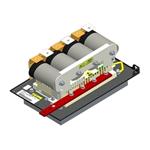
IGBT power modules integrate multiple switching devices, gate drivers, and protection circuits into single packages designed for specific applications. A three-phase motor drive module contains six IGBTs with anti-parallel diodes, gate driver circuits for all positions, and comprehensive protection - everything needed for the complete power stage except the DC bus capacitors and output filters.
The integration begins with the power semiconductors themselves. Modern modules from Infineon Technologies and onsemi use direct copper bonding technology that bonds semiconductor dies directly to copper substrates. This construction minimizes thermal resistance whilst providing excellent current distribution across large die areas.
Gate driver integration eliminates external gate drive circuit design. The drivers embedded within the module feature optimized layouts that minimize parasitic inductance in critical gate loop paths. This reduces switching losses and electromagnetic interference whilst improving reliability by eliminating potential layout errors in external gate drive circuits.
Built-in protection circuits monitor critical parameters continuously. Short-circuit protection detects abnormal collector-emitter voltage within 2 to 10 microseconds and disables the gate drive before device destruction occurs. Temperature sensors embedded near the semiconductor dies provide accurate thermal monitoring that enables protective shutdown before junction temperatures reach dangerous levels.
Thermal Management: From Challenge to Advantage
Heat dissipation represents the primary reliability concern in high-power electronics. Junction temperature directly affects IGBT lifetime; every 10°C reduction approximately doubles device lifespan. Integrated modules transform thermal management from a design challenge into a built-in advantage.
The thermal path from semiconductor junction to heatsink mounting surface receives careful optimization during module design. Direct bonded copper substrates provide low thermal resistance (typically 0.01°C to 0.03°C per watt between die and substrate). The base plate material and thickness balance thermal conductivity with mechanical stress management during thermal cycling.
Module manufacturers characterize thermal performance comprehensively, providing accurate thermal resistance values for all thermal paths. This eliminates guesswork in thermal calculations and enables precise heatsink specification. Many modules include thermal interface material pre-applied to the base plate, ensuring optimal thermal coupling without assembly concerns about interface thickness or coverage.
Power cycling capability (the number of temperature cycles from ambient to maximum junction temperature that the module withstands) benefits from integrated design. Manufacturers engineer modules specifically for applications with frequent thermal cycling, using reinforced wire bonding and substrate attachment techniques that resist fatigue failure.
Simplified Design Process and Reduced Development Time
The complexity reduction from using integrated modules directly translates to shorter development cycles. Gate drive timing optimization, protection circuit tuning, and thermal interface design (tasks requiring weeks in discrete designs) become specification exercises when using modules.
Layout complexity drops substantially. Instead of routing high-current paths, gate drive signals, and sense connections across multiple boards, the design interfaces with a single module through standardized connectors. This simplification reduces PCB layer count, manufacturing complexity, and assembly costs.
Testing and validation become more straightforward. Module manufacturers provide comprehensive characterization data including switching waveforms under various load conditions, thermal performance curves, and protection circuit response times. This documented performance reduces the validation testing required before production release.
Design reuse improves across product families. A well-characterized module can serve multiple applications with different power levels by simply paralleling devices or selecting different current ratings within the same package family. The gate drive and protection circuitry scale automatically with the power semiconductors.
Protection Features That Prevent Catastrophic Failures
Built-in protection circuits in integrated modules respond faster and more reliably than external protection implementations. The proximity between sensing circuits and power devices eliminates propagation delays introduced by board-level connections.
Short-circuit protection activates within microseconds when collector-emitter voltage exceeds expected saturation voltage during conduction. The protection circuit transitions the IGBT into an active region that limits current whilst maintaining control, then initiates controlled shutdown that prevents voltage spikes from inductive load energy.
Active clamping during turn-off limits collector-emitter voltage to safe levels even when switching highly inductive loads. This protection prevents voltage overshoot that could exceed device ratings during fault conditions or unexpected load changes.
Interlock functions prevent both upper and lower devices in a half-bridge configuration from conducting simultaneously. Deadtime generation ensures one device turns off completely before the opposite device receives gate drive signals, preventing shoot-through currents that destroy power stages instantly.
Application-Specific Optimization
Module manufacturers offer variants optimized for specific applications. Motor drive modules include features relevant to variable-frequency drives: low inductance construction for clean switching, integrated brake choppers, and thermistor inputs for motor temperature monitoring.
Renewable energy modules designed for solar and wind inverters emphasize efficiency across wide power ranges. These modules use optimized gate drive timing that reduces switching losses during the partial-load operation typical in renewable installations. Microchip Technology provides intelligent power modules with integrated control functions suited for renewable energy applications.
Traction modules for electric vehicles and rail systems feature ultra-low inductance packaging that enables very fast switching with minimal electromagnetic interference. Automotive-grade qualification ensures operation through extreme temperature ranges and vibration environments that standard industrial modules might not withstand.
Selection Criteria for Your Application
Choosing the right IGBT module requires matching several parameters to application requirements:
Current rating should include margin for peak currents during starting and fault conditions. Module ratings specify continuous current at a defined case temperature. Verify that your cooling system maintains case temperature within these limits.
Voltage rating must exceed the maximum DC bus voltage with adequate margin for transient overvoltages. Industrial drives typically use 1200V modules for 690V AC systems and 1700V modules for medium-voltage applications.
Switching frequency capability determines whether the module suits your application. Motor drives typically switch at 4kHz to 16kHz, whilst some renewable energy applications operate at 20kHz or higher for reduced filter requirements.
Thermal characteristics including thermal resistance and power cycling capability must align with your operating profile. Applications with frequent starts and stops require modules rated for extensive thermal cycling.
Frequently Asked Questions
How do integrated modules compare in cost to discrete designs?
Whilst module unit costs exceed discrete component costs, the total system cost typically favours modules when accounting for reduced development time, simpler PCB design, lower assembly costs, and improved reliability that reduces warranty expenses.
Can modules be paralleled for higher current applications?
Yes, modules can be paralleled when current sharing and matched switching characteristics are ensured. Manufacturers often provide guidance on paralleling techniques and offer matched sets for this purpose.
What happens when protection circuits activate?
Most modules provide fault status outputs that signal the control system when protection activates. The module typically enters a safe state with outputs disabled, requiring a reset signal before resuming operation after the fault condition clears.
Building Reliable High-Power Systems
Integrated IGBT modules transform high-power drive development from managing complex discrete designs to selecting optimised solutions that combine proven technology with comprehensive protection. The thermal management advantages and reduced design complexity enable faster development of reliable power electronics.
At TRX Electronics, we supply IGBT power modules from leading manufacturers through our partnerships with Mouser Electronics and TTI Inc. Our technical knowledge helps you navigate module selection for your specific application requirements.
Ready to simplify your next high-power design? Contact our team and let us help you select the right power modules for your industrial applications.