
- Home Page
- My Account
- New Products
- Contact Us
-
Semiconductors
-
Circuit Protection
- Back
- Circuit Breakers & Accessories
- Circuit Protection Kits
- ESD Suppressors / TVS Diodes
- Fuse Holders
-
Fuses
- Gas Discharge Tubes - GDTs / Gas Plasma Arrestors
- LED Protection Devices
-
Power Outlet Strips
- Back
- Power Outlet Strips
- Resettable Fuses - PPTC
-
Surge Suppressors
- Back
- Surge Suppressors
-
Thermal Cutoffs
- Back
- Thermal Cutoffs
- Thermistors
- Thyristors
- Varistors
-
Connectors
-
Embedded Solutions
-
Enclosures
-
Engineering Development Tools
-
Industrial Automation
-
LED Lighting
-
Optoelectronics
- Passive Components
-
Power
- Sensors
-
Test & Measurement
-
Tools & Supplies
-
Wire & Cable
-
Opto-electronics
- ON Semiconductor LM324
-
Electromechanical
- Back
- Audio Devices
-
Circuit Breakers
- Back
- Circuit Breakers
-
Encoders
- Back
- Encoders
- Hardware
-
I/O Modules
- Back
- I/O Modules
- VCC 06-03
-
Thermal Management
- Home Page
- My Account
- New Products
- Contact Us
-
Semiconductors
-
Circuit Protection
- Back
- Circuit Breakers & Accessories
- Circuit Protection Kits
- ESD Suppressors / TVS Diodes
- Fuse Holders
-
Fuses
- Gas Discharge Tubes - GDTs / Gas Plasma Arrestors
- LED Protection Devices
-
Power Outlet Strips
- Back
- Power Outlet Strips
- Resettable Fuses - PPTC
-
Surge Suppressors
- Back
- Surge Suppressors
-
Thermal Cutoffs
- Back
- Thermal Cutoffs
- Thermistors
- Thyristors
- Varistors
-
Connectors
-
Embedded Solutions
-
Enclosures
-
Engineering Development Tools
-
Industrial Automation
-
LED Lighting
-
Optoelectronics
- Passive Components
-
Power
- Sensors
-
Test & Measurement
-
Tools & Supplies
-
Wire & Cable
-
Opto-electronics
- ON Semiconductor LM324
-
Electromechanical
- Back
- Audio Devices
-
Circuit Breakers
- Back
- Circuit Breakers
-
Encoders
- Back
- Encoders
- Hardware
-
I/O Modules
- Back
- I/O Modules
- VCC 06-03
-
Thermal Management
- Home /
- All Products /
- Semiconductors /
- Thyristors /
- SCR Modules
SCR Modules
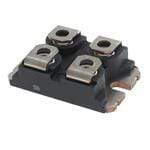
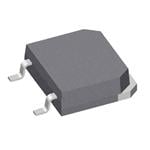
SCR modules are thyristor devices — 4-layer PNPN structures that latch into conduction when a gate pulse fires them and stay on until anode current drops below the holding current (IH). That latching behaviour is what makes them the standard for phase-angle control of resistive heaters, AC motors, and lamp dimmers at line frequency. They are not IGBTs and not MOSFETs — trying to use them for high-frequency switching is a design error. SCR modules package one or more thyristors with dielectric isolation in standard power module housings: TO-240, TO-268, and SOT-227 are the common footprints.
Configuration follows the load. A single SCR suits half-wave or DC-bus firing circuits. Anti-parallel pairs handle full AC cycles without a bypass diode — the standard arrangement for AC heater control. SCR/diode combinations work in half-controlled bridge topologies where you only need one-quadrant control and want to keep cost down. Full thyristor bridges cover reversible drives, electrochemical processes, and anywhere you need bidirectional current.
Specifying the right module comes down to a short list of parameters: VDRM (repetitive peak off-state voltage — leave margin above your worst-case line transients), IT(AV) (average on-state current, not RMS; the ratio between them shifts with conduction angle), and ITSM for fuse coordination under fault conditions. Gate trigger current (IGT) and holding current (IH) need to match your firing circuit. dV/dt rating is easy to overlook — fast anode voltage transients on inductive loads can cause spurious turn-on without a snubber. Thermal resistance junction-to-case and whether the base is isolated or non-isolated determines how you design the heatsink stack.
TRX sources SCR modules from Infineon, ON Semiconductor, STMicroelectronics, and Littelfuse through authorised distribution. No minimum order, so you can pull units to qualify a design before production quantities. In-stock lines ship to Johannesburg, Cape Town, Durban, and Pretoria. For parts that need to be sourced, we'll quote you an actual lead time.
Send us your part number or describe the application — we'll come back with availability and pricing.



- 697 Jacques Street, Moreleta Park, Pretoria
- [email protected]
- +27 (0)12 997-0504